Currently added about a clay tablet recovered and added as part of the story
Avatar-afbeelding
The Sumerian Tablet That Says You Can Refuse Reincarnation — And Describes What Happens If You Do
18,7K abonnees
Abonneren
242
Delen
5 jun 2026
Love ancient mysteries, lost civilizations, and hidden knowledge from humanity’s oldest texts? Subscribe now and join us for more fascinating journeys into the secrets of the ancient world! / @theobsidianvaultus
What if an ancient Sumerian tablet suggested that reincarnation is not inevitable? And what if it described a way for a soul to refuse the cycle entirely—along with the mysterious consequences of that choice?
In this video, we explore the intriguing claims surrounding a Sumerian tablet said to discuss the fate of the soul, the possibility of refusing reincarnation, and what awaits those who choose a different path. Originating from one of the world’s earliest civilizations, these ancient writings have inspired debate among historians, mythology enthusiasts, and seekers of esoteric knowledge for generations.
Could the tablet be preserving a symbolic spiritual teaching? Was it describing ancient beliefs about the afterlife, divine judgment, and the journey beyond death? Or have modern interpretations transformed a mythological text into something far more mysterious than its original meaning? These questions continue to fuel fascination with the wisdom and cosmology of ancient Mesopotamia.
We’ll examine the historical context of Sumerian religion, the meaning of cuneiform inscriptions, ancient concepts of the soul, and the broader mythology that shaped one of the first great civilizations in human history. Along the way, we’ll explore forgotten traditions, ancient spiritual beliefs, archaeological discoveries, and the enduring mysteries that still surround humanity’s oldest written records.
Whether you’re interested in ancient history, mythology, reincarnation theories, spiritual traditions, archaeology, lost knowledge, or unexplained mysteries, this investigation offers a thought-provoking look into one of the most fascinating claims connected to the ancient Sumerians.
There is a clay tablet sitting in a locked university archive in southern Germany. It is small, about the size of a man’s palm. It is broken at one corner. It has been there since 1974, and almost no one has ever seen it. The tablet is Sumerian. It is roughly 4,700 years old, and it describes in detail that no one was prepared for.
A procedure, a procedure that the scribe who wrote it claimed could be used to
step out of the cycle of death and return, not to die well, not to be reborn into a better life, to exit permanently. The tablet is real. The translation exists. And what it says happens to the ones who exit is the part the academic world cannot make peace with. The tablet was unearthed in 1962 during a salvage excavation near the ruins of Tel al-Mukayar, the old religious heart of the expedition was Iraqi le with two Danish observers attached and the dig was not a glamorous one.
It was rescue archaeology. The water table had risen, salts were eating the bricks. The lower chambers of a small priestly compound were collapsing and the team had a few weeks to pull out what they could before the whole quarter sank into mud.
They pulled out hundreds of objects. Most were ordinary ration receipts, beer accounts, the kind of paperwork that ran a temple.
But in a sealed cedar box lined with bitumen and tucked into a wall recess that had been deliberately bricked over, they found seven tablets. Six of them were standard surgical texts. The seventh was something else. The seventh tablet was cataloged as K 3,891.
The box itself was unusual. Sumerian lurggical archives when they were stored long-term were normally placed on shelves in dedicated archive rooms organized by subject and indexed on clay catalog tags.
They were not bricked into walls. The cedar of the box was old growth imported from the Levant and the bitumin lining was thick enough to seal the box against moisture and rodents almost indefinitely.
Someone at some point in the priestly compound’s history had taken K 3,891 out of its normal storage location, placed it in a custom container along with six unrelated texts and walled it up.
The choice was deliberate. Whoever did this expected the tablet to be found again, but only by someone willing to break through walls.
K. 3,891
went into a transit crate, traveled with the collection to Baghdad, sat in storage for 10 years, and was then loaned quietly to a German university for translation.
The German team passed it on to a single specialist, a man named Dr. Henrik Sorenson. Sorenson was a Danish Assyriologist. He was in his late 50s when he received K3891.
He had spent three decades translating Sumerian liturgy, and he had a reputation for being uninterested in speculation of any kind.
He was not the man you brought a strange tablet to if you wanted excitement.
He was the man you brought it to if you wanted the translation to be boring, accurate, and unimpeachable.
He had K 3,891 for 9 years. He never published on it. He never lectured on it.
He filed three internal progress reports, all of them in Danish, all of them marked confidential.
And in the third report, he requested permission to stop work entirely.
The permission was not granted, he continued.
Colleagues who saw him during those nine years reported that he became progressively quieter. He stopped attending faculty dinners. He no longer wrote book reviews for the journals he had once edited.
A junior colleague who shared an office wall with him said that on more than one
occasion, she heard him speaking late in the evening to no one, not in Danish, not in English.
In what she described when asked years later as something rhythmic and continental that she did not recognize.
He finished his translation in 1983. He delivered it to the German faculty in a single sealed envelope, asked that it not be opened until after his death and walked out of the building. He retired the following month. He died in 1991
in a small village outside Arus.
The envelope was opened. The translation was read and the tablet has been in restricted access ever since.
What follows is what Dr. Sorenson translated.
12 codes, 12 sections of text.
The scribe who wrote the original called them the 12 instructions.
The translation calls them codes because the language is technical, not poetic. This is not a hymn. This is a manual.
One more thing about Sorenson before we begin. In the first of his three internal progress reports filed 18 months into the translation, he attached a single handwritten note to the cover page.
The note was not part of the formal document. It was addressed to whichever colleague would eventually take over the work if he were unable to finish.
The note said that the tablet should be approached the way a physicist approaches a foreign instrument.
Read it carefully. Test the translation against itself.
Do not under any circumstance attempt to act on what it describes until you have read it in full at least three times. He underlined the words at least three times.
The note has been preserved in the German archive. It is the only piece of personal commentary Sorenson ever attached to the work.
Now, before we go further, I need to pause for a second because what I’m about to tell you gets significantly darker. And I realized a while ago that some of this
cannot be fully explained in a video format.
The complete decoding of all 12 codes, the tablet numbers, the translated passages, the astronomical date they specified down to the degree, I put it all into a written document.
It’s linked below and the QR code is on your screen. Now, let’s continue.
Code one, the wheel.
The first code describes what reincarnation actually is.
According to the scribe, the description is not what most religious traditions teach. The scribe does not call it a wheel of becoming or a ladder of souls.
SHe calls it a holding system, a penned enclosure. The Sumerian word is closer to what a herdsman would use for a sheepfold than what a priest would use for a divine cycle.
Souls, he writes, are not freely moving between bodies.
They are kept inside a structure. And the structure has walls.
The walls, he says, are not made of stone. They are made of forgetfulness.
Every time a soul exits a body, it enters a corridor. The corridor washes the memory. The memory is not erased by accident. It is erased on purpose.
Because if the memory were not erased, the soul would refuse to re-enter.
Code two, the keepers. The second code describes who runs the holding system.
The tablet uses a word that has been argued about for a century. Sometimes translated as judges, sometimes as gatekeepers. S
Sorenson translated it as the assessors.
He noted the word is functional, not honorific. They are not gods. They are not demons. They are staff.
The job is to receive incoming souls, log them, prepare them, and return them to the system.
The assessors, the tablet says, were installed. The word for installed is the same word a Sumerian engineer would use for a sledge gate or a canal lock.
Something put in place to control flow.
Someone built the system.
Someone runs it. And the someone is not the same as the gods who created the world.
The system was added later.
Code three, the corridor.
The third code describes what the soul experiences between lives. The scribe gives a sequence.
First, the soul becomes aware that it is no longer in a body.
Second, it is met. Third, it is shown. Fourth, it is invited.
Fifth, it is sent. The meeting is brief. The showing is longer.
The soul is shown its previous life in a compressed playback. Every choice, every consequence. The scribe calls it a weighing, but the weighing is not a moral judgment.
It is a calibration. The next placement is being prepared. The inviting is the part almost no one talks about.
The soul is offered a next body. It is shown the parents. It is shown the conditions.
The scribe says, “The soul almost always accepts because the showing has been carefully tuned.
The next life is presented in a way that obscures its real difficulty.
The soul drained, eager to continue, says yes. The sending is the memory wipe.”
And then the soul is in a new body.
Code four, the contract. The fourth code is the most unsettling so far.
And Sorenson flagged it three separate times in his marginal notes.
The scribe says that the acceptance is not just a choice. It is recorded.
There is a contract. The soul agrees in the corridor to the terms of the next life and the contract is binding within the system.
The binding mechanism is not described in detail. The scribe says only that the soul carries a mark after the agreement. The mark is not visible.
It is a kind of resonance, a signature, and the assessors use it to track the soul across incarnations.
If the soul tries to deviate, the mark draws it back.
The contract enforces itself. The western reader will think of medieval packs.
The scribe does not frame it that way. He frames it the way a Sumerian tax official would frame a debt obligation.
The system needs continuity.
It is not malevolent. It is administrative, but it is also inescapable within the system.
Code 5, the lure.
The fifth code is where the tablet starts to feel less like a description and more like a warning.
The scribe says the system is maintained in part by the soul’s own appetite.
Every incarnation generates desire. Desire generates unfinished business.
Unfinished business generates the felt need to return. The scribe names three lures.
The lure of incompleteness, the feeling that you did not finish what you came to do.
The lure of attachment, the feeling that you cannot leave the people you loved.
And the lure of curiosity, the feeling that the next life might be the one that finally makes sense.
All three, the scribe says, are real feelings. But the corridor, the showing, the inviting, are arranged.
So these feelings are most active at the moment of agreement. The soul is not deceived.???
The soul is leaned on and the lures intensify across lifetimes.
Code six, the awakening.
The sixth code describes what happens very rarely when a soul begins to remember while still inside a living body. The memory wipe is not perfect. Sometimes fragments leak through. The scribe lists the signs.
A persistent feeling that none of this is real. A recurring dream of a corridor.
a sense of being watched from somewhere just behind your own thoughts, an explained dread at the moment of falling asleep.
He says, “These are not symptoms of mental illness. They are evidence the wipe is failing on you.”
Sorenson wrote in the margin next to this section, the word careful, underlined twice.
Code seven, the first refusal. The seventh code is where the tablet stops being descriptive and becomes instructional.
The scribe says a soul that has begun to remember can at the next corridor refuse the invitation.
When the assessor shows the next body, the soul must say no. The saying is not verbal. It is intentional. The soul must hold against the pressure of the lures.
The position that it will not enter another contract. The assessor cannot compel acceptance. Without agreement, the system has no jurisdiction. But the system does not let the soul go easily.
There is what the scribe calls the second showing.
Code 8, the second showing. The eighth code describes what happens immediately after refusal. The scribe says the assessor will return, the corridor will dim, and the soul will be shown a different invitation, a better one, better parents, better
circumstances, a life of meaning, a life of love.
The scribe calls this the sweetened offer. He says it can be presented multiple times, each more attractive than the last.
The soul at this point is alone, exhausted, and the offers are gentle.
The greater number of souls accept the sweetened offer. The refusal collapses. The contract is signed. The wipe occurs. The soul wakes in a new body with no
memory of having ever resisted.
A few, he says, do not accept.
Code 9, the threshold.
The ninth code is the one Sorenson circled most frequently in his working notes, and it is the code the next pause refers to.
The scribe gives a number. He says that of every 10,000 souls who reach the corridor, only a specific count will complete the exit.
The number is seven. 7 out of 10,000. He also gives a condition.
The exit window is not always open. It opens, he says, when the wheel slows.
When certain astronomical positions align. When the count of souls inside the system has reached a particular threshold. He gives the threshold.
He gives the trigger. He gives the next predicted opening. The translation of that section is in the document linked below.
Before we move on to the next code, stop for a second. What you just heard about code 9 is the part that changes everything.
But it only makes sense when you see it written out next to the original Sumerian notation. The population number, the trigger conditions. It’s all in the document linked below.
Take 5 seconds right now. Grab it and then come back because what comes next builds directly on it. The link is in the description. QR code is on your screen.
Code 10, the exit.
The 10th code describes what the soul actually does. In the moment the threshold is reached and the refusal holds. The scribe does not describe it as a passage.
He describes it as a discharge. The mark, the resonance left by previous contracts
dissolves. The soul is no longer trackable by the assessors. It is no longer in the corridor.
It is no longer in the system. What comes next is where the language of the tablet becomes the strangest.
The scribe says there are three paths. The first path is what he calls the upward path.
The soul that
exits the wheel moves toward what he calls the original light. He does not say what the original light is. He says only that the soul un-tracked and unwiped recognizes the light as the place it came from before any of this began.
The recognition is described as relief.
The second path is what he calls the lateral path. Some souls on exit do not move upward.
They move sideways.
They go into what the scribe calls the unwritten field. He explains the unwritten field only with metaphor. It is the part of existence the system never indexed.
It is not heaven. It is not paradise. It is what was here before the wheel was built.
And it is described as immense, quiet, and largely unpopulated. The soul that takes the lateral path simply walks into it and becomes, in his words, one of the unwritten.
The third path is the one the scribe spends the most ink on.
He calls it the return path, the voluntary return. A soul that has exited the wheel can of its own choosing come back.
Not under contract, not with a wipe. The soul returns as itself, with its memory intact, into a new body.
This kind of return, the scribe says, is extremely rare, and it is the only kind of return that the system cannot record.
Code 11, the signal. The 11th code is short and almost technical.
The scribe says that souls who have exited by any of the three paths leave a residual signature. The signature is not detectable inside the system where the assessors operate, but it is detectable, he says, by other exited souls.
And it is detectable by the part of the living human that is not yet wiped in the quiet moments before sleep.
The signal is what he calls a long tone. He compares it to the hum of a stretched cord.
He says, “People who have been close in any incarnation to a soul that exited can
sometimes hear the tone in dreams or in moments of stillness.
The tone is not a message. It is a presence. It is in his phrasing the way the unwritten ones say they are still here. The scribe also says, and this is the part that has been quoted by everyone who has read the translation, that the tone increases in frequency in certain eras. He calls these eras the waking’s.
He gives no specific dates, but he says the tone becomes loud enough in a waking that ordinary people begin to notice it. They begin to feel watched. They begin to dream of corridors. They begin to ask questions the system cannot answer.
The scribe says the present generation, his own, may be in awakening.
He is writing in roughly 2700 BC, code 12, the convergence.
The 12th and final code is the shortest of all 12 and the most ambiguous.
Sorenson translated it twice and noted the alternate reading in his file.
The scribe says that the system, the wheel, the corridor, the assessors, the contracts, the wipes, all of it is not permanent.
The system, he writes, was built. what is built can be unbuilt.
He says there will come a time when the count of refusals exceeds the count of acceptances. When more souls walk out than agree to return at that point, he
says the system loses critical mass. The assessors no longer have enough flow to maintain operations.
The corridor begins to thin. The scribe does not predict when this happens.
He says only that the wakings are the warning. Each waking is a test of whether the threshold has been reached.
He says the errors that fail to reach it are forgotten. The era that succeeds will end the wheel entirely.
That is the 12th code. That is where the tablet ends.
So, what do we do with this? A 4,700-year-old clay tablet translated by a man who
never spoke about it in public describing the architecture of reincarnation in the language of an engineer.
There are broadly three ways to read it.
The first reading is forgery. A modern fabrication slipped into the catalog.
This is the default skeptical reading.
The problem is that K3,891 has been carbon dated twice on the bitumen seal of the box. Both dates returned within standard error.
The other six tablets in the box are unimpeachably ancient. The clay matches the regional clay of for the 3rd millennium BC. If it is a forgery, it is one so technically perfect that the forgery itself would be a more remarkable discovery than the contents.
The second reading is symbolic. a religious text in the Gnostic mode written by a heterodox priest describing what we would today call a spiritual
allegory. The wheel is a metaphor for attachment. The assessors are metaphors for the conditioning forces of culture.
The exit is enlightenment. Read this way. The tablet is unusual but not impossible. There are echoes in later traditions.
The Gnostic texts describe a similar architecture with archons standing in for the assessors and the demiurge standing in for the system.
The Tibetan Bardau literature describes corridors and choices and reluctant returns.
The hermetic writings of late antiquity describe ascent paths and the shedding of veils.
Even the modern near-death experience literature contains language strikingly similar to the scribes.
Raymond Moody, the American physician who in 1975 compiled accounts from patients revived after cardiac arrest, recorded recurring elements the scribe would have recognized. A tunnel or corridor, a presence perceived as evaluator, a review of the life just lived, a choice to return.
Pim Vanl, the Dutch cardiologist who in 2001 published a Lancet study on near-death experiences among resuscitated cardiac patients, found the same pattern a quarter century later. The Life Review, the presence of guides, the feeling of being offered a return, the reluctance of the soul to come back.
20th century cardiac patients with no access to Sumerian liturgy described the same architecture in different words.
The third reading is the one Sorenson seemed to settle into in his final progress
report. The reading is that the tablet is descriptive, not metaphorical, not symbolic.
A document written by someone who believed he was reporting on a real mechanism in the same pros register a Sumerian engineer would use to describe a real canal.
If that reading is correct, then everything later religious literature said about reincarnation is downstream of this document and the document itself is downstream of someone who claimed to know the mechanism firsthand.
Either the scribe was that person or the scribe was transcribing the testimony of
that person.
There are a few other facts about K3,891 that are worth knowing before we close.
The first is that the Iraqi Archaeological Agency in the early 1970s opened an internal inquiry about the original excavation. The inquiry concerned not the tablet itself, but the location of the cedar box. The box had been bricked into a wall recess in a subordinate chamber of the priestly compound behind two layers of mortar in a way clearly intended to conceal it permanently.
The other six tablets in the box were unremarkable liturgical texts.
Why would six unremarkable texts be sealed into a wall with such effort alongside a seventh that did not match them?
The inquiry concluded after 18 months that the six were camouflage. They were chosen because they were unremarkable.
The point of the concealment was the seventh K3,891 had been hidden deliberately by someone in antiquity who did not want it found.
The second fact concerns Dr. Sorenson’s last year. He moved after retirement to a small house on the western coast of Jutland. He saw no one. His former colleagues received occasional brief formal letters.
In his final two months, he wrote by hand a 40-page document that he asked his
housekeeper to mail to a single recipient in Switzerland after his death. The recipient was a private collector. The document has never surfaced publicly.
The housekeeper asked later what she remembered of those weeks said only that Sorenson seemed at peace.
She said he told her the morning before he died that he had finished the work and was ready to go where the tablet pointed.
She did not know what he meant.
The third fact concerns the tablet itself. K3,891 is still in the locked archive in southern Germany. The German university has declined on three occasions to authorize its transfer to a more accessible collection.
The official reason is conservation. The unofficial reason given by one staff member to a researcher who asked the right question was different.
The staff member said the tablet has a way of changing people who read it too long. The staff member did not elaborate.
The researcher who wrote up the exchange in a private email later leaked online said the staff member would not look at him while he said it.
So here is where we are. A tablet sealed in a wall by someone who did not want it found.
A translator who finished it asked it be kept until after his death and then quietly went to where it pointed.
A storage room in southern Germany, three readings, each with its own difficulties, and 12 codes that describe in the pros of an engineer what the cycle of death and return actually is, who runs it, why we keep agreeing to come back, and how to stop.
The scribe wrote the tablet during what he believed was a waking. He wrote it down so that the few who could hear the tone would have a reference.
He did not expect the average reader to understand it. He said in a line near the end that Sorenson translated and underlined that the tablet is not for everyone.
It is for the ones who have already begun to remember. If you have been listening this far, and any of this has produced a quiet recognition rather than a confused dismissal, the scribe would have said, “You are already in the early stages.
The corridor, in his view, is not far.
The choices are real. The contract has not yet been signed. And the next time you find yourself in the moments before sleep dreading something you cannot name, the scribe would say, “You are not imagining it.
You are hearing the tone.
The Sumerians wrote it down. They wrote it down so we would know.
The question is whether anyone finally is listening.
Sleep well.
——————————————————————————————
Breaking the Karmic Contract and the Gnostic Way to Stop Reincarnating Forever
Gnosis Unveiled
1,62K abonnees
Abonneren
251
Delen
3.869 weergaven 6 dec 2025
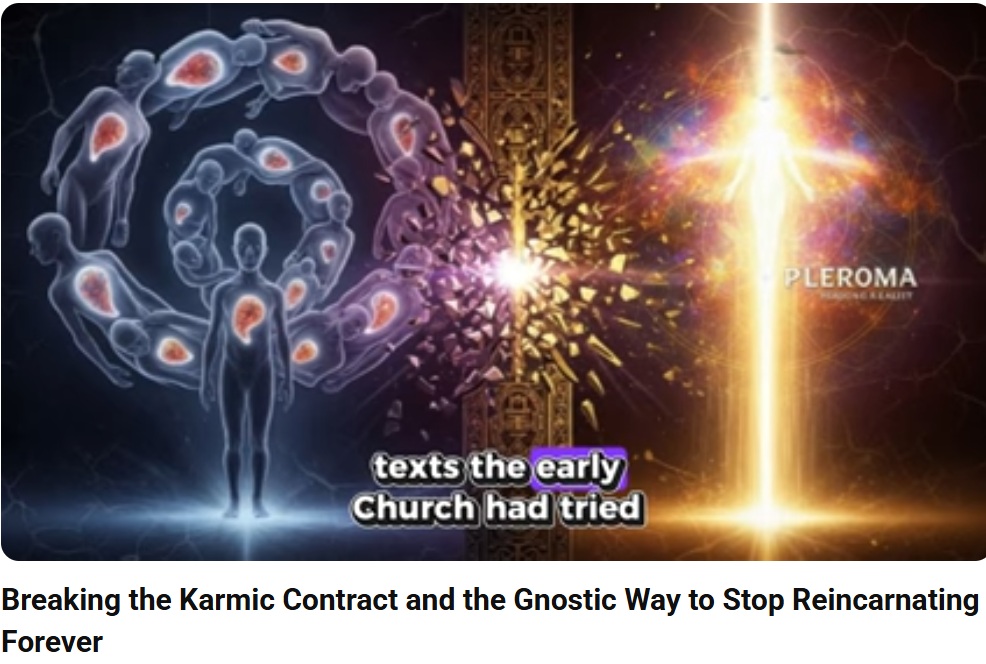
What if karma is not divine justice but a contract designed to keep you trapped in endless reincarnation? The ancient Gnostics discovered that the cycle of birth and death is not a path to spiritual growth but a prison system engineered by the Archons to recycle souls through lifetimes of forgetfulness.
In this video we explore the hidden Gnostic teachings about karma, reincarnation, and the Archontic control system that keeps humanity bound to the material world. You will learn why the Gnostics believed karma is chains not balance, how the life review after death is used to bind souls back into incarnation, and the exact methods they taught to break free from the wheel of rebirth forever.
Discover the truth hidden in the Nag Hammadi texts about the karmic contract, how the Archons use guilt and attachment to pull souls back to Earth, and the Gnostic practice of gnosis that dissolves the agreement. This is not about learning more lessons or balancing debts. This is about remembering your divine origin and reclaiming your sovereignty beyond the prison of matter.
If you are ready to see through the illusion and understand how to void the karmic contract, this video will give you the knowledge the spiritual teachers never share. The wheel only turns as long as you believe it must. Break the belief and you break the cycle.
Sources include the Apocryphon of John, Pistis Sophia, the First Apocalypse of James, and other Gnostic scriptures from the Nag Hammadi Library.
Subscribe to the Gnostic Eye for more hidden wisdom about the Archons, the Demiurge, ancient mysteries, and the path to true spiritual liberation.
Transcript
https://www.youtube.com/watch?v=Xh7LHn5tx3Q original video link
https://www.youtube.com/watch?v=Xh7LHn5tx3Q
They told you that you chose to come back, that your soul signed up for lessons, that reincarnation is a gift.
But what if you have been lied to from the very beginning? Because according to
the Gnostics, karma is not a law of the universe.
It is a trap, a contract forged by the archons to keep you recycling through lifetimes, forgetting who you are while they harvest what you produce.
And tonight you will learn how to void that contract.
Most people never question it. They accept the story they were given. You live, you die, you come back. You learn lessons. You pay debts. You evolve. It sounds spiritual. It sounds fair. But the ancient Gnostics saw through it.
They called karma something very different. They called it chains.
And they warned that reincarnation was not a path to enlightenment, but a
mechanism of imprisonment designed by forces that feed on your return.
In 1945, beneath the cliffs of Nag Hamadi in Egypt, a farmer unearthed a
sealed jar. Inside were texts hidden for over 1600 years. Texts the early church
had tried to erase.
Among them were the writings of the Gnostics. mystics who claimed the world itself was a trap, a construct built by a false god they called the demiurge.
And according to these texts, the cycle of birth and death, the very system we
call reincarnation was the cornerstone of that trap. The Gnostics believed something radical.
They said that karma is not divine law. It is programming. a set of cords, weights, and illusions designed to convince your soul that it must return.
Every unfinished desire, every guilt, every belief that you owe the universe
something, every teaching that says you need one more lifetime to learn, to
grow, to balance the scales.
All of it is part of the contract. A contract you never consciously signed, but one that binds you nonetheless.
Think about it. How many spiritual traditions tell you that you chose to be
here? That before birth, your soul sat in some cosmic council and agreed to
this life, to these challenges, to these pains?
It sounds empowering at first, but here is the question the Gnostics would ask.
If you truly chose this, then why do you not remember choosing it?
Why does every soul arrive in a body with total amnesia? No memory of the
agreement, no recollection of the lessons, no awareness of the contract at
all.
And if you cannot remember agreeing, can it truly be called consent? The Gnostics said no. They taught that the amnesia itself is part of the design. You forget who you are, where you came from, and what you are capable of.
You are born into a world of distraction, fear, and survival. And by the time you die, you are so disoriented, so desperate for comfort, so longing for reunion that you will agree to almost anything.
That is when the contract is renewed. Not before birth, but after death, in
the very moment when you are most vulnerable.
According to the Gnostic texts, after death, the soul does not simply ascend.
It encounters powers, the archons, cosmic rulers who govern the layers of reality between earth and the true source.
These beings do not serve the highest divine. They serve the demiurge, the architect of matter, the false god who believes himself supreme.
And their role is not to guide you home. It is to turn you around and send you back.
The Apocryphon of John describes this process in chilling detail.
When the soul departs the body, it rises through the planetary spheres, each one ruled by an archon. At each gate, the soul is questioned, judged, weighed.
The archons examine your deeds, your attachments, your fears. They show you what you did wrong, what you failed to complete, what you still desire.
They make you feel the weight of it all. And then they offer you a solution.
Return, go back and fix it. Learn the lesson. Pay the debt. Balance the karma.
But here is what they do not tell you.
The debt is never real. The lesson is never finished. The karma is never truly
balanced because the system itself is designed to be endless.
Every lifetime creates new karma. Every action generates new consequences.
Every attachment forms new chords. And so the wheel keeps turning. You live. You die. You forget. You return again and again and again.
Not because you need to, but because you have been convinced that you must.
The Gnostics saw this clearly.
They understood that karma, as taught by the archons, is not justice.
It is entanglement. It is a web of cause and effect so intricate, so overwhelming
that the soul believes it can never escape.
And the more you believe in karma, the more power it has over you.
Because belief is consent. and consent renews the contract. So, how does the contract work?
How do the archons bind a soul without physical chains? The answer lies
in frequency.
The Gnostics taught that the material world operates on a specific vibration, a density of consciousness that keeps you locked in the cycle of matter. fear, guilt, shame, attachment, desire.
These emotional states all vibrate at frequencies that align with the arantic realm. When you hold these emotions, you remain tethered to the wheel.
This is why after death, during what many call the life review, you are shown everything you did, everything you felt, every mistake, every regret.
The purpose is not healing. The purpose is to amplify those low frequency emotions. Guilt for what you did wrong, attachment to what you left behind, desire for what you never achieved, fear of what comes next.
And in that amplified state, you become easy to redirect.
The archons do not need to force you back.
They simply need to make you believe you belong there.
And once you believe it, you walk into the next lifetime willingly thinking it was your choice.
The Pist Sophia describes a similar process. It speaks of rulers who bind souls with cords of karma, invisible threads woven from unresolved emotions and unfinished business.
These cords pull the soul back toward incarnation like a magnet drawing metal.
And the soul convinced it must resolve these debts agrees to return.
But the debts are never resolved. They are simply replaced with new ones. The game
is rigged and the only way to win is to stop playing.
But if karma is a trap, if reincarnation is a prison, then what is the alternative?
The Gnostics did not teach nihilism.
They did not say life is meaningless. They said life in matter is not your
true home. Your essence, your divine spark comes from beyond this realm.
It comes from the plleoma, the fullness, the realm of pure light and
consciousness where the true divine resides. And the goal is not to perfect
yourself within the prison. The goal is to remember who you are and return to
the source.
This is where the gnostic concept of noses becomes essential.
Nosis means direct knowledge, inner knowing, a remembrance that bypasses belief and touches truth.
It is not intellectual. It is experiential.
And it changes everything. Because the moment you remember that you are not a
product of this world, that you do not owe the demiurge anything, that your
essence is eternal and free, the contract begins to lose its power.
The Gnostics taught specific methods to break free. The first step is awareness.
You must see the trap for what it is. You must recognize that karma as
presented by the archons is not universal law but a localized rule within their domain.
Outside their realm in the true plleoma, karma does not exist. Cause and effect do not bind you.
You are not a debtor. You are a child of the infinite source. The second step is
detachment. This does not mean apathy.
It means releasing the emotional cords that tie you to the material plane.
Every fear, every guilt, every unfinished desire is a hook. And the archons use those hooks to pull you back.
By observing these emotions without identifying with them, by recognizing them as temporary experiences rather than your true self, you begin to cut the cords.
The third step is remembrance. In the Gnostic tradition, this was often done through meditation, prayer, and the repetition of sacred words or names. The purpose was not to worship external powers but to reconnect with the divine spark within.
To remember that you are not this body, not this personality, not this lifetime.
You are a fragment of the eternal source, temporarily clothed in matter, but never truly bound by it.
The Gnostics also spoke of passwords and seals, symbolic phrases and inner
recognitions that allowed the awakened soul to pass through the arc gates
without being detained.
These were not literal passwords you speak aloud. They were states of
consciousness, frequencies of awareness that the archons could not touch.
When the soul held the recognition of its true origin, when it declared its
connection to the Plleoma, the archons had no authority over it.
The first apocalypse of James describes this process. It tells of a soul ascending
through the realms of the rulers. At each gate, the archons demand to know
who the soul is, where it comes from, where it is going.
And the soul responds not with fear or apology but with authority. It declares its divine origin.
It states that it comes from the realm of light, that it belongs to the plleoma, that it is returning to the source. And at this declaration, the archons step aside because they can only bind what consents to be bound.
And a soul that remembers its truth does not consent.
But here is the deeper challenge. The archons are not the only obstacle. The
real prison is internal. It is the part of you that believes you are guilty,
that you owe something, that you need to return.
That belief is what keeps the contract active. And as long as you hold
it, no amount of external knowledge will set you free. This is why nosis is not
just information. It is transformation.
It is the shift from believing you are a sinner in need of redemption to knowing
you are a divine spark that never fell.
So how do you begin this process now in this lifetime before death arrives?
The Gnostics offered practical steps.
First cultivate stillness. In silence, you can observe the mind and see which
thoughts are truly yours and which are whispers from the arctic field.
Most people never pause long enough to notice the difference. But when you do, you
realize that much of what you think, dear, and desire is not original to you.
It was planted. Second, practice detachment from outcomes. The archons thrive on your attachment to results, to achievements, to the unfinished business of life.
When you release the need for things to be a certain way, when you accept that this lifetime is temporary and that your essence is eternal, the hooks begin to lose their grip.
Third, question every belief you hold about karma and reincarnation.
Ask yourself, where did I learn this?
Who taught me that I must come back?
What evidence do I have that I chose to be here? And most importantly, do I feel
free in this belief? Or do I feel bound by it? If the belief creates fear,
guilt, or obligation, it is likely part of the contract.
Fourth, reclaim your sovereignty. The archons can only control what you give them permission to control.
Every time you say, “I must learn this lesson. I must balance this karma.
I must return to fix this.” You renew the contract. But the moment you say, “I do not consent. I am not bound by these rules. I am a sovereign being of light.” You begin to dissolve the agreement. And finally, remember the light. Not the false light that dazzles and demands, but the true light of the purled, the radiance that liberates rather than binds.
The Gnostics taught that this light is within you always. It is your divine spark, your connection to the source. And when you turn your attention inward, when you focus on that spark rather than the external illusions, you align with a frequency
that the archons cannot touch.
This is the path the Gnostics walked.
Not a path of escaping life through despair, but a path of seeing through
life with clarity. They lived in the world, but did not belong to it. They
participated in matter, but did not identify with it. And when death came,
they were ready.
They knew the traps. They knew the illusions. They knew the contract. And
they knew how to void it. So what does this mean for you? It means you have a
choice. You can continue to believe the stories you were given.
That karma is sacred, that reincarnation is necessary, that you must return until you get it right.
Or you can question those stories. You can see them for what they are.
Control mechanisms designed to keep you cycling through lifetimes, forgetting who you are.
While the archons harvest the energy you produce. The karmic contract is not written in stone. It is written in belief. And belief can be changed.
The moment you withdraw your consent, the moment you remember your divine origin, the moment you declare that you do not owe this realm anything, the contract begins to dissolve. You do not need permission from a teacher, a guru, or a cosmic council.
You are already free. You just forgot. And perhaps that is the greatest secret of all. The prison was never real. The karma was never mandatory. The reincarnation cycle was never inevitable.
It was all a story. A very convincing story told by forces that benefit from your return.
But you are not a character in their story. You are a divine spark, a fragment of the infinite source, temporarily experiencing matter but never truly bound by it.
So when the time comes, when death arrives and the tunnel of light appears,
when the voices call and the life review begins, remember this. You do not owe
them anything. You are not obligated to return. You are not bound by karma. You
are free. You have always been free. And the moment you remember that, the
contract is void.
The Gnostics left these teachings not as dogma, but as keys. Keys to unlock the door you did not know was closed. Keys to break the chains you did not know you wore. And now those keys are in your hands. The question is not whether you can break the karmic contract. The question is will you? Because the wheel will keep
turning as long as you let it. But the moment you step off, the moment you
reclaim your sovereignty and remember your divinity, the cycle ends.
Not because you perfected yourself within the prison, but because you finally saw
the prison for what it was, an illusion, a contract, a trap, and you chose to
walk away. The karmic contract has held humanity captive for thousands of years.
Not through force, but through belief.
Every time you accept that you owe something, that you must return, that
you need one more lifetime to get it right, you renew the agreement.
But the Gnostics proved that the contract is not binding. It never was.
It exists only in the realm of consent, and consent can be withdrawn.
The wheel turns only as long as you believe it must. The moment you remember
your divine origin, the moment you reclaim your sovereignty, the cycle ends, not because you earned your freedom, but because you finally remembered you were always free.
If this knowledge opened your eyes to something you have been seeking, do not let it end here. Hit that like button to help this message reach others who are ready to
break free. Subscribe to the Gnostic Eye and turn on notifications so you never
miss the hidden truths they tried to bury.
The Archons want you to forget that you just learned. Subscribing is your declaration that you will not drop a comment below and share what resonated
with you most.
Your voice matters and remember the prison only exists if you believe in it.
Stay awake. Stay sovereign. The journey does not end here.
Leave a Reply